Dory documentation
Dory is the brand for Agent Computers by ComputeEngines: persistent Linux computers for software development and for AI agents. A Dory computer is a full virtual machine with a desktop, SSH, Docker and Chromium. You have root inside it. Use it as a development machine, or let an agent run commands, edit files and drive the browser through an API.
Dory is in development. The invite-only beta has not opened yet, and prices and limits in these pages are planned and may change. The documentation describes the product as it is designed to work at launch so that you can evaluate it and prepare your own tooling. Hostnames such as agents.computeengines.com and api.agents.computeengines.com are the ones the product is designed to use.
Start with the Quickstart to create a computer, run a command, read a file, look at its desktop, open a preview, pause, resume and delete it. The examples are supplied in curl, Python and TypeScript, with a separate CLI walkthrough. Use with AI agents describes the MCP and computer-use interfaces.
Two APIs, one computer
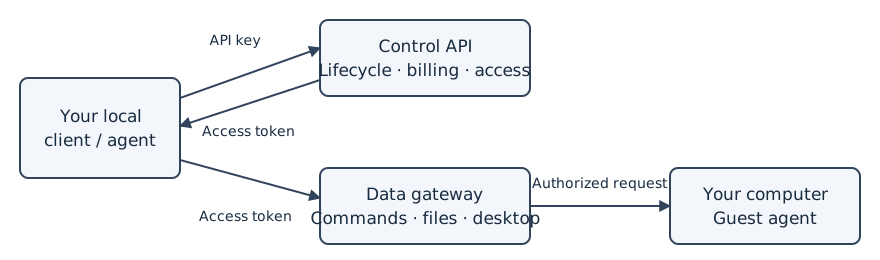
| Plane | What it does | Credential |
|---|---|---|
| Control API | Account and billing reads, computer creation and lifecycle, access-token issuance | API key, scoped and restricted for the intended work |
| Data API | Commands, processes, files, desktop, browser and ports | Short-lived access token for one computer and the allowed data scopes |
The Python and TypeScript clients exchange the API key for access tokens as needed. The curl walkthrough makes that exchange explicit. Keep the API key on your local machine; do not place it inside the remote computer or commit it. Access-token expiry, a command deadline and the computer's run timer are separate limits. Background processes survive an HTTP disconnect and token expiry; stop, reboot, lifecycle restrictions and balance limits still apply.
Choose a lifecycle and a budget
On-demand computers charge for running compute, with a monthly cap shared with their own stored disk and saved memory. Pause preserves memory for resume; stop does not. Always-on computers retain capacity subject to the documented low-balance rules. A top-up does not start a computer. Read Pricing and billing for the planned prices, storage and traffic charges and the low-balance timeline.
Lifecycle operations may return an accepted operation before the requested state is reached. The SDK create/start/resume/pause waiters validate the final state; a local timeout does not cancel the server operation. Retain resource IDs and idempotency keys after an uncertain outcome, and do not blindly repeat an action that may already have run.
Read the limits first
All computers run in one location in New Jersey, on hardware we operate. There is no availability promise, GPU or nested virtualization. Outbound IPv4 is shared by accounts in the same tier, mail ports are blocked, and public access is through the documented paths. Read Honest limits before choosing this service for a workload.
Terms and policies will be published before the beta opens.
Where things are
- API reference for every customer-facing HTTP operation, rendered from the OpenAPI description.
- Python SDK, TypeScript SDK, the cec command line and the MCP tools.
- Status for what exists today and what comes before the beta.
- Whitepaper for what the service is and is not.
Dory is in development; these pages describe the planned service and may change. Questions: support@computeengines.com.